
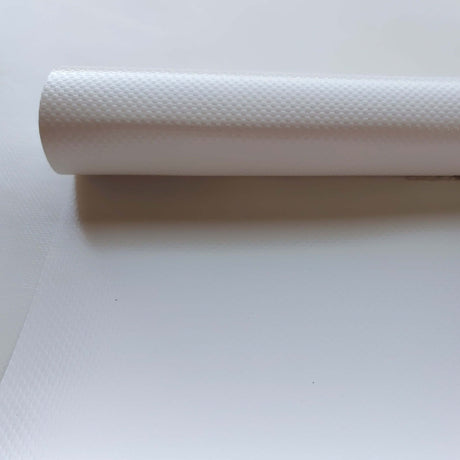
 The customized requirements of the construction industry are reflected in the special performance parameters. In the construction project of China Zun Building, the fireproof pvc tarpaulin used has a combustion performance meeting the GB8624 B1 grade standard, with an oxygen index exceeding 32% and a smoke density grade of less than 65. These materials adopt a double-layer composite structure with a 0.15mm aluminum foil reflective layer added in the middle, which increases the thermal reflectivity to 88%. Project records show that this customized solution has reduced the energy consumption for temperature regulation at the construction site by 35% and extended the service life of materials to 2.3 times that of conventional products.
The application customization of the environmental protection industry demonstrates technological breakthroughs. Among the pollution control systems recommended by the European Environment Agency in 2024, the chemical-resistant PVC tarpaulin can withstand acidic and alkaline environments with pH values ranging from 2 to 12, and its permeability is less than 0.01g/m²/24h. In a certain contaminated site remediation project in Germany, a custom-developed composite tarpaulin containing an activated carbon adsorption layer achieved a VOCs retention efficiency of 99.7%, effectively preventing the spread of harmful gases. The service life of this material reaches 60 months, which is 2.5 times that of ordinary materials.
The customized demands of special industries drive technological innovation. The low-temperature resistant PVC tarpaulin used in polar scientific research still maintains flexibility in an environment of -55℃, and its breaking strength retention rate reaches 85%. The custom-made tarpaulin used by the 2023 Antarctic research team features a three-layer insulation structure, with a thermal conductivity coefficient reduced to 0.023W/(m·K), maintaining a temperature difference of over 40℃ between indoors and outdoors. Although the unit price of these high-performance customized products is 3.2 times that of the standard ones, they have extended the equipment's service life from 2 years to 7 years, significantly improving the overall cost-effectiveness.
The customized requirements of the construction industry are reflected in the special performance parameters. In the construction project of China Zun Building, the fireproof pvc tarpaulin used has a combustion performance meeting the GB8624 B1 grade standard, with an oxygen index exceeding 32% and a smoke density grade of less than 65. These materials adopt a double-layer composite structure with a 0.15mm aluminum foil reflective layer added in the middle, which increases the thermal reflectivity to 88%. Project records show that this customized solution has reduced the energy consumption for temperature regulation at the construction site by 35% and extended the service life of materials to 2.3 times that of conventional products.
The application customization of the environmental protection industry demonstrates technological breakthroughs. Among the pollution control systems recommended by the European Environment Agency in 2024, the chemical-resistant PVC tarpaulin can withstand acidic and alkaline environments with pH values ranging from 2 to 12, and its permeability is less than 0.01g/m²/24h. In a certain contaminated site remediation project in Germany, a custom-developed composite tarpaulin containing an activated carbon adsorption layer achieved a VOCs retention efficiency of 99.7%, effectively preventing the spread of harmful gases. The service life of this material reaches 60 months, which is 2.5 times that of ordinary materials.
The customized demands of special industries drive technological innovation. The low-temperature resistant PVC tarpaulin used in polar scientific research still maintains flexibility in an environment of -55℃, and its breaking strength retention rate reaches 85%. The custom-made tarpaulin used by the 2023 Antarctic research team features a three-layer insulation structure, with a thermal conductivity coefficient reduced to 0.023W/(m·K), maintaining a temperature difference of over 40℃ between indoors and outdoors. Although the unit price of these high-performance customized products is 3.2 times that of the standard ones, they have extended the equipment's service life from 2 years to 7 years, significantly improving the overall cost-effectiveness.
Can PVC Tarpaulin Be Customized for Different Industries?
The customization capability of PVC tarpaulins has been fully demonstrated in the agricultural sector. According to the data from the 2023 International Agricultural Science and Technology Exhibition, PVC tarpaulin designed for greenhouse sheds can be precisely customized within a thickness range of 0.15mm to 0.35mm, and the light transmittance can be adjusted between 45% and 90%. In the intelligent greenhouse project built by COFCO Group in Northeast China, the customized PVC tarpaulin used contains 5% special ultraviolet blocker, which keeps the temperature fluctuation inside the greenhouse within ±2℃ and shortens the average growth cycle of crops by 18%.
Customized solutions for the logistics industry are more technologically advanced. The "Smart Cover" project implemented by DHL Supply Chain in 2024 uses PVC tarpaulins embedded with RFID chips. These customized materials have a uniform thickness of 0.72mm, a tensile strength of 6000N/5cm, and contain 32 micro-sensors per square meter. This innovative design enables the environmental data collection accuracy during the cargo transportation process to reach 98%, and the cargo damage rate has decreased by 43% year-on-year. Data shows that although the initial cost of customized tarpaulins increases by 25%, the transportation efficiency improves by 31%, shortening the investment payback period to 14 months.
The customized requirements of the construction industry are reflected in the special performance parameters. In the construction project of China Zun Building, the fireproof pvc tarpaulin used has a combustion performance meeting the GB8624 B1 grade standard, with an oxygen index exceeding 32% and a smoke density grade of less than 65. These materials adopt a double-layer composite structure with a 0.15mm aluminum foil reflective layer added in the middle, which increases the thermal reflectivity to 88%. Project records show that this customized solution has reduced the energy consumption for temperature regulation at the construction site by 35% and extended the service life of materials to 2.3 times that of conventional products.
The application customization of the environmental protection industry demonstrates technological breakthroughs. Among the pollution control systems recommended by the European Environment Agency in 2024, the chemical-resistant PVC tarpaulin can withstand acidic and alkaline environments with pH values ranging from 2 to 12, and its permeability is less than 0.01g/m²/24h. In a certain contaminated site remediation project in Germany, a custom-developed composite tarpaulin containing an activated carbon adsorption layer achieved a VOCs retention efficiency of 99.7%, effectively preventing the spread of harmful gases. The service life of this material reaches 60 months, which is 2.5 times that of ordinary materials.
The customized demands of special industries drive technological innovation. The low-temperature resistant PVC tarpaulin used in polar scientific research still maintains flexibility in an environment of -55℃, and its breaking strength retention rate reaches 85%. The custom-made tarpaulin used by the 2023 Antarctic research team features a three-layer insulation structure, with a thermal conductivity coefficient reduced to 0.023W/(m·K), maintaining a temperature difference of over 40℃ between indoors and outdoors. Although the unit price of these high-performance customized products is 3.2 times that of the standard ones, they have extended the equipment's service life from 2 years to 7 years, significantly improving the overall cost-effectiveness.
The customized requirements of the construction industry are reflected in the special performance parameters. In the construction project of China Zun Building, the fireproof pvc tarpaulin used has a combustion performance meeting the GB8624 B1 grade standard, with an oxygen index exceeding 32% and a smoke density grade of less than 65. These materials adopt a double-layer composite structure with a 0.15mm aluminum foil reflective layer added in the middle, which increases the thermal reflectivity to 88%. Project records show that this customized solution has reduced the energy consumption for temperature regulation at the construction site by 35% and extended the service life of materials to 2.3 times that of conventional products.
The application customization of the environmental protection industry demonstrates technological breakthroughs. Among the pollution control systems recommended by the European Environment Agency in 2024, the chemical-resistant PVC tarpaulin can withstand acidic and alkaline environments with pH values ranging from 2 to 12, and its permeability is less than 0.01g/m²/24h. In a certain contaminated site remediation project in Germany, a custom-developed composite tarpaulin containing an activated carbon adsorption layer achieved a VOCs retention efficiency of 99.7%, effectively preventing the spread of harmful gases. The service life of this material reaches 60 months, which is 2.5 times that of ordinary materials.
The customized demands of special industries drive technological innovation. The low-temperature resistant PVC tarpaulin used in polar scientific research still maintains flexibility in an environment of -55℃, and its breaking strength retention rate reaches 85%. The custom-made tarpaulin used by the 2023 Antarctic research team features a three-layer insulation structure, with a thermal conductivity coefficient reduced to 0.023W/(m·K), maintaining a temperature difference of over 40℃ between indoors and outdoors. Although the unit price of these high-performance customized products is 3.2 times that of the standard ones, they have extended the equipment's service life from 2 years to 7 years, significantly improving the overall cost-effectiveness.