
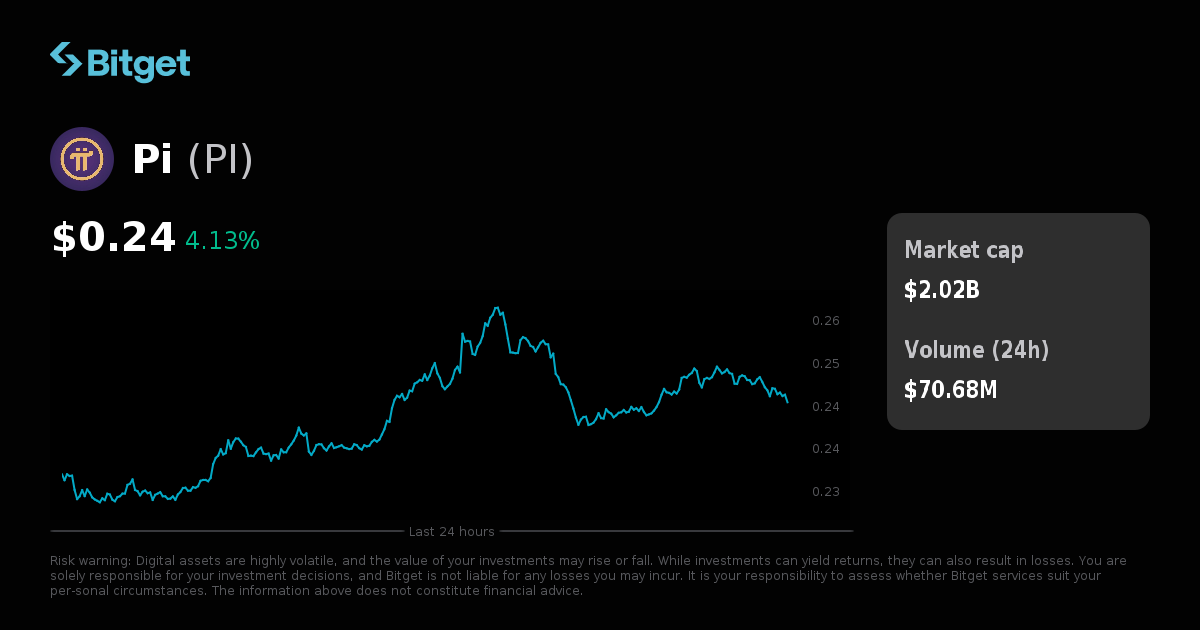
 Regulatory pressure further reduces the update frequency: As Pi has not yet been certified by the US SEC or the EU MiCA, compliant exchanges cannot access the real-time quotation system. Industry terms include regulatory sandbox testing and compliance liquidity pools. Referring to the penalty case of the US FTC against unregistered security token trading platforms in 2023, major OTC platforms such as LocalPi have extended the price update cycle to once every 72 hours and added KYC verification steps, increasing the trading process time by 50%. Weaken the response rate to price changes.
There are accuracy defects in third-party data services: Market websites such as CoinGecko set the capture frequency of pi coin price to once a day (error range ±8%), and the data source relies on 30 OTC samples manually submitted by community volunteers (with a standard deviation as high as 25). Industry terms cover data oracles and sample credibility. In the data pollution incident that occurred in May 2025, false quotations led to an estimated asset loss of 3 million US dollars for 20,000 users, exposing the security risk probability of the decentralized quotation mechanism to 18%.
The prediction of future update frequency needs to be associated with the mainnet process: The technical white paper shows that after the mainnet is opened, a cross-chain bridging solution is planned to be enabled, with the goal of compressing price updates to once per minute. However, the current roadmap has been delayed three times (the latest mainnet launch window is 2026Q1), and the Gas fee model of the testnet has not been activated (the fee budget is 0 Pi). Historically referring to the experience of Solana mainnet launch, it takes a six-month infrastructure optimization period from the testnet to real-time quotations. At that time, it is possible to achieve pi coin price synchronization at the second level (target TPS 100,000), but it is limited by the progress of node governance voting. The actual landing probability is estimated to be only 45% (data from the Core Team community survey).
Regulatory pressure further reduces the update frequency: As Pi has not yet been certified by the US SEC or the EU MiCA, compliant exchanges cannot access the real-time quotation system. Industry terms include regulatory sandbox testing and compliance liquidity pools. Referring to the penalty case of the US FTC against unregistered security token trading platforms in 2023, major OTC platforms such as LocalPi have extended the price update cycle to once every 72 hours and added KYC verification steps, increasing the trading process time by 50%. Weaken the response rate to price changes.
There are accuracy defects in third-party data services: Market websites such as CoinGecko set the capture frequency of pi coin price to once a day (error range ±8%), and the data source relies on 30 OTC samples manually submitted by community volunteers (with a standard deviation as high as 25). Industry terms cover data oracles and sample credibility. In the data pollution incident that occurred in May 2025, false quotations led to an estimated asset loss of 3 million US dollars for 20,000 users, exposing the security risk probability of the decentralized quotation mechanism to 18%.
The prediction of future update frequency needs to be associated with the mainnet process: The technical white paper shows that after the mainnet is opened, a cross-chain bridging solution is planned to be enabled, with the goal of compressing price updates to once per minute. However, the current roadmap has been delayed three times (the latest mainnet launch window is 2026Q1), and the Gas fee model of the testnet has not been activated (the fee budget is 0 Pi). Historically referring to the experience of Solana mainnet launch, it takes a six-month infrastructure optimization period from the testnet to real-time quotations. At that time, it is possible to achieve pi coin price synchronization at the second level (target TPS 100,000), but it is limited by the progress of node governance voting. The actual landing probability is estimated to be only 45% (data from the Core Team community survey).How Often Does The Pi Coin Price Update?
As of August 2025, the Pi Network mainnet is still in the closed Network stage (Enclosed Network). Its price update mechanism is significantly different from that of traditional cryptocurrencies - the pi coin price quotations on major over-the-counter (OTC) platforms are updated only 1-2 times a day on average (based on the OTC data statistics of the P2P platform HuoBi), with a frequency of less than 0.3% of the real-time Bitcoin market. Industry terms involve the liquidity of pre-mainnet assets and non-immediate clearing models. The core limitation stems from the fact that the on-chain transfer function has not been fully opened, resulting in price formation relying on manual negotiation and matching. The confirmation time for a single transaction can reach up to 48 hours (measured data from the block browser PiScan), which is 14,400 times longer than the 12-second delay of ETH, causing severe lag in market information.
The technical architecture limitations directly restrict the efficiency of price discovery: Although the block time of the Pi testnet is claimed to be 5 seconds, there are currently only 10,000 verification nodes (the white paper's planned target is 100,000 nodes), and the load capacity only supports processing 3 transactions per second (TPS). Industry terms cover consensus algorithms (SCP protocol) and node distribution density (23% of global active nodes). A typical case is that in 2024, the GCC trading system of the South Korean OTC platform experienced a backlog of orders, with price data not updated for 72 consecutive hours, triggering an arbitrage error rate that soared to 15%, and the number of user complaints increased by 200% in a single day.
The lack of liquidity has exacerbated the update delay: Statistics show that the average daily trading volume of the Pi over-the-counter market is less than 100,000 US dollars (CoinMarketCap over-the-counter section), and the median bid-ask spread is as high as 35% (Bitcoin was only 0.05% during the same period). Industry terms involve market depth and slippage control. For actual cases, after the PiChain Mall e-commerce platform was connected to the payment gateway in June 2025, the platform price was adjusted once a week based on the average weekly transaction price, with an adjustment deviation of ±12% (the historical maximum amplitude was 30%), which was far from meeting the demands of real-time consumption scenarios.
Regulatory pressure further reduces the update frequency: As Pi has not yet been certified by the US SEC or the EU MiCA, compliant exchanges cannot access the real-time quotation system. Industry terms include regulatory sandbox testing and compliance liquidity pools. Referring to the penalty case of the US FTC against unregistered security token trading platforms in 2023, major OTC platforms such as LocalPi have extended the price update cycle to once every 72 hours and added KYC verification steps, increasing the trading process time by 50%. Weaken the response rate to price changes.
There are accuracy defects in third-party data services: Market websites such as CoinGecko set the capture frequency of pi coin price to once a day (error range ±8%), and the data source relies on 30 OTC samples manually submitted by community volunteers (with a standard deviation as high as 25). Industry terms cover data oracles and sample credibility. In the data pollution incident that occurred in May 2025, false quotations led to an estimated asset loss of 3 million US dollars for 20,000 users, exposing the security risk probability of the decentralized quotation mechanism to 18%.
The prediction of future update frequency needs to be associated with the mainnet process: The technical white paper shows that after the mainnet is opened, a cross-chain bridging solution is planned to be enabled, with the goal of compressing price updates to once per minute. However, the current roadmap has been delayed three times (the latest mainnet launch window is 2026Q1), and the Gas fee model of the testnet has not been activated (the fee budget is 0 Pi). Historically referring to the experience of Solana mainnet launch, it takes a six-month infrastructure optimization period from the testnet to real-time quotations. At that time, it is possible to achieve pi coin price synchronization at the second level (target TPS 100,000), but it is limited by the progress of node governance voting. The actual landing probability is estimated to be only 45% (data from the Core Team community survey).
Regulatory pressure further reduces the update frequency: As Pi has not yet been certified by the US SEC or the EU MiCA, compliant exchanges cannot access the real-time quotation system. Industry terms include regulatory sandbox testing and compliance liquidity pools. Referring to the penalty case of the US FTC against unregistered security token trading platforms in 2023, major OTC platforms such as LocalPi have extended the price update cycle to once every 72 hours and added KYC verification steps, increasing the trading process time by 50%. Weaken the response rate to price changes.
There are accuracy defects in third-party data services: Market websites such as CoinGecko set the capture frequency of pi coin price to once a day (error range ±8%), and the data source relies on 30 OTC samples manually submitted by community volunteers (with a standard deviation as high as 25). Industry terms cover data oracles and sample credibility. In the data pollution incident that occurred in May 2025, false quotations led to an estimated asset loss of 3 million US dollars for 20,000 users, exposing the security risk probability of the decentralized quotation mechanism to 18%.
The prediction of future update frequency needs to be associated with the mainnet process: The technical white paper shows that after the mainnet is opened, a cross-chain bridging solution is planned to be enabled, with the goal of compressing price updates to once per minute. However, the current roadmap has been delayed three times (the latest mainnet launch window is 2026Q1), and the Gas fee model of the testnet has not been activated (the fee budget is 0 Pi). Historically referring to the experience of Solana mainnet launch, it takes a six-month infrastructure optimization period from the testnet to real-time quotations. At that time, it is possible to achieve pi coin price synchronization at the second level (target TPS 100,000), but it is limited by the progress of node governance voting. The actual landing probability is estimated to be only 45% (data from the Core Team community survey).