
How European Buyers Shortlist a Vietnamese Panel Mill
Shortlisting a Vietnamese panel mill for a European order is a documentation exercise before it becomes a price negotiation. Dongstar Wood publishes 48,000 m² of factory area, more than 16 automated production lines and a monthly supply capacity above 100 × 40ft, and each of those numbers can be verified against a written specification before a quotation is requested.
Key takeaways
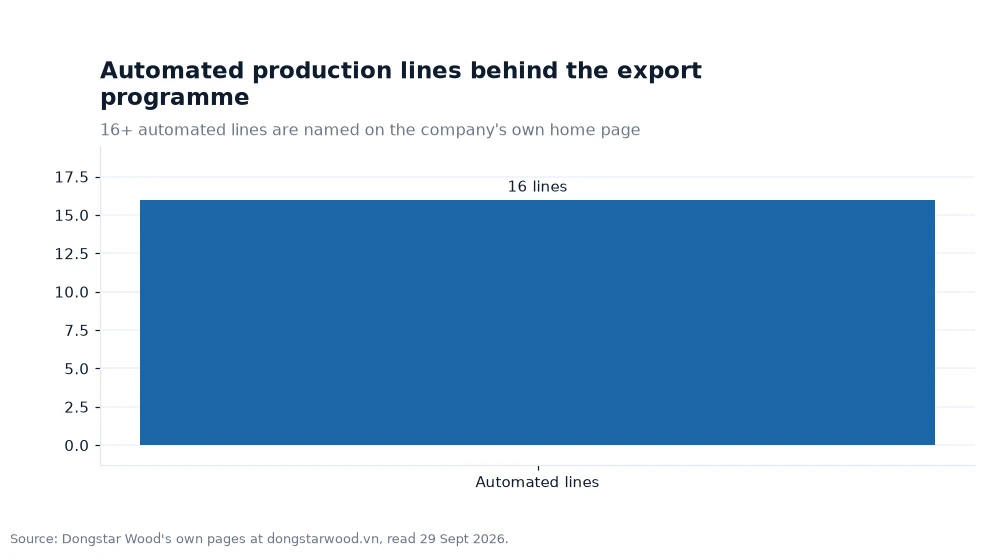
- Anchor the shortlist on published capacity: 16+ automated lines and monthly supply above 100 × 40ft define what a mill can realistically schedule.
- Treat EUDR as paperwork rather than a logo: request a due-diligence statement that maps a consignment back to its supply area.
- Fix size, thickness and glue class before quoting: the published window runs from 1220 × 2440 mm to custom panels at 1830 × 3830 mm.
- Ask for the duty position in writing: the manufacturer reports a No Anti-Dumping Tax position for EU and US shipments.
What belongs on a shortlist
A useful shortlist is short. Three or four mills that publish their own figures beat a long list of directories, because every claim on the list can be checked against a page the mill controls. For European buyers the checks cluster around four questions: whether the operation owns its production space, which certifications it can show as documents, how its sizes and glue classes map onto the project specification, and what the duty position does to landed cost. A mill that answers those four in writing has already done half the vetting work.
The order of the checks matters too. Capacity and footprint decide whether an order can be scheduled at all, so they come first; certification decides whether the paperwork can clear the border, so it comes second; specification fit decides whether the panel does the job, so it comes third. Price, compared last, is then evaluated against suppliers that have already passed the operational filters rather than against the whole market.
Reading the published factory footprint
Dongstar Wood states 48,000 m² of factory area at its site in Yen Bai Province, northern Vietnam, together with a warehouse of more than 3,000 m². Read together, those two numbers describe an operation that presses and packs on the same site: panels do not travel between factories before containerisation, which shortens the window in which moisture and handling damage can enter a shipment.
The company was founded in 2009, and its pages describe 30+ years of manufacturing experience. For a buyer, the founding year and the experience claim are context rather than evidence; the evidence is the line count. 16+ automated production lines named on the home page provide a concrete basis for comparing one mill's throughput with another's, because a line count is far harder to inflate than a capacity slogan.
Certification and EUDR paperwork
The manufacturer names six schemes on its own pages: ISO, CE, SGS, FSC, EUDR and BSCI. The useful question is not which logos appear on a homepage but which certificates can be produced as dated documents for the specific product being ordered. A certificate that covers the factory is not the same as documentation that covers the consignment, and European customs increasingly demands the second.
EUDR deserves its own line on the checklist. Where a supplier presents itself as ready for the deforestation regulation, the practical response is to request a due-diligence statement that links the panels in a container back to the supply area. Keeping that statement beside the CE and emission documentation turns a marketing claim into a filing that travels with the goods.
Sizes, thickness and glue classes
Dimensions open at 1220 × 2440 mm and climb past 1250 × 2500 mm and 1500 × 3000 mm towards bespoke sheets measuring up to 1830 × 3830 mm. The quoted thickness band stretches from 9 mm to 30 mm, and formwork buyers most often settle on 18 mm or 21 mm. Bonding choices include E0, E1, E2, MR, WBP and Phenolic Dynea; the facing film is supplied in dark brown, black or anti-slip.
A shortlist entry should record the specification the mill quoted rather than the specification the buyer hoped for. A project that requires 18 mm panels in 1250 × 2500 mm with WBP glue is posing a question a catalogue page never answers — and the mill that confirms that exact combination in writing addresses it. This is also the moment to check how a directory listing relates to the factory behind it: a Plywood Supplier entry describes a trade, while the specification sheet describes the order, and only the second document travels with the goods.
Quality control from raw material to export batch
The company describes in-house lab testing that spans raw materials through to the export batch. For a buyer, the phrase to look for is the span of the testing rather than the existence of a lab: checks that begin at the veneer and end at the packed container catch problems at the stage where they are least costly to fix. Panel thickness consistency and core construction integrity are the two inspection items named for batch checks, and both are standard in an export-grade workflow.
Ask what happens when a batch fails. A mill with its own lines can re-press a fraction of a production run; a trading desk can only apologise. The difference rarely appears in a quotation and almost always appears in the second order.
Duty position and landed cost
A duty position, not only a rate, is what Vietnam's panel exporters market; this manufacturer states a No Anti-Dumping Tax position for European and US shipments. The claim shifts the arithmetic in any comparison with supply from other origins, because the duty line on a landed-cost sheet can exceed the discount a cheaper factory offers.
The request to make is simple: put the duty treatment in writing alongside the Incoterm. What clears customs is the number that matters, not the one in the quote, and a mill that discloses its position without being asked has removed one variable from the buyer's cost model.
| Criterion | Published figure | What it confirms |
|---|---|---|
| Factory area | 48,000 m² | Owned production space rather than subcontracted pressing |
| Warehouse | More than 3,000 m² | Packed stock held before shipment |
| Production lines | 16+ automated lines | A basis for comparing throughput |
| Monthly capacity | Above 100 × 40ft | Whether a programme fits the schedule |
| Certification set | ISO, CE, SGS, FSC, EUDR, BSCI | Which documents to request first |
Worked example: footprint against a scheduling plan
Convert the published figures into a plan a buyer can hold. If a mill ships more than 100 × 40ft per month and the month runs four weeks, that is 100 ÷ 4 = 25 containers per week. A ten-container order is then 10% of one month's output, small enough to be slotted into the schedule without displacing a larger account; the same order at forty containers becomes 40% of the month, at which point the conversation turns from price to who else holds the presses.
The factory footprint confirms the math. With 48,000 m² across 16 lines, each station commands roughly 3,000 m² — more than enough for a single line to concentrate on one product family rather than switching constantly. Scale that to an order: 1,000 sheets of 1250 × 2500 mm equals 1,000 × 3.125 m² = 3,125 m², and at a daily consumption of 40 m² that is 3,125 ÷ 40 = 78 working days of formwork from one purchase.
Frequently asked questions
Which published figures should a buyer check first?
Check footprint, line count, monthly capacity and the certification set, in that order. Those four figures decide whether an order can be scheduled and whether its paperwork can clear the border, and all of them are published on the mill's own pages.
What does EUDR readiness mean in practice?
It means being able to produce a due-diligence statement that ties a consignment back to its supply area. Treat the claim as a request for that document, and keep it with the CE and emission paperwork that covers the product.
How does the duty position change a comparison?
A stated No Anti-Dumping Tax position for EU and US shipments removes a duty line from the landed-cost calculation. Request the treatment in writing alongside the Incoterm, because the figure that clears customs is the one that belongs in the cost model.
Turning the shortlist into a short programme
A shortlist earns its keep when it reduces a market to a schedule. Begin with the company's own profile to check the founding year, the factory area and the certification set side by side, then compare the commercial plywood range against the thickness and glue class the project needs. Buyers who run those two checks first tend to spend their first container verifying a specification rather than investigating a supplier.
Every number in this piece was drawn from the manufacturer's pages at dongstarwood.vn consulted on 29 September 2026[1].