
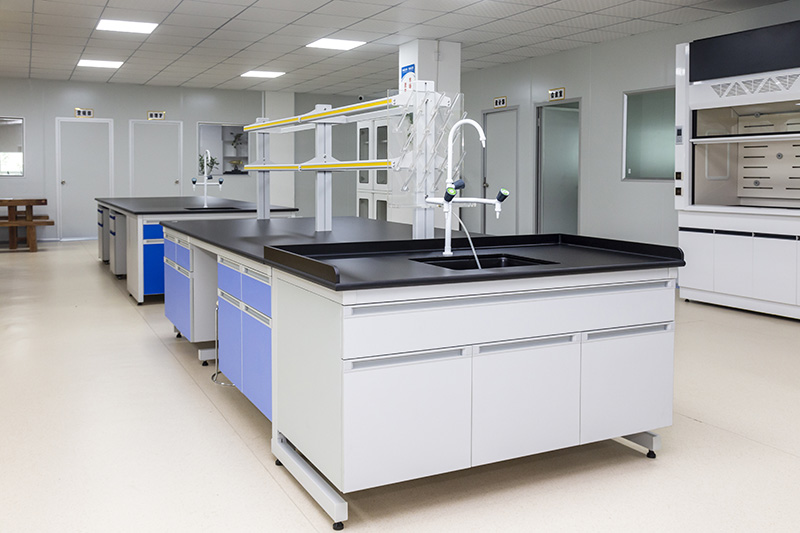
 The modular and flexible design concept has reached a new height. The modern system enables users to complete the laboratory layout reorganization within 48 hours, and the cost of space reconfiguration is 60% lower than that of a fixed layout. Industry reports show that furniture systems with standardized interfaces can increase equipment upgrade efficiency by 70% and achieve interface compatibility of 95%. Among the successful cases of the Cambridge CRISPR gene editing platform, its workbench module supports switching between molecular biology and cell culture functional modes within 2 hours, reducing the start-up cycle of interdisciplinary projects from 3 months to 2 weeks. This design philosophy is like providing scientific research with Lego block-like infinite possibilities.
A breakthrough has been made in the application of digital twin technology. Avant-garde manufacturers create 1:1 virtual models for projects, which can detect 90% of potential conflicts before construction and reduce the on-site modification rate from 18% to less than 3%. The Munich R&D center of BMW Group has utilized this technology to connect 5,000 data points to the management platform, increasing energy utilization efficiency by 22% and optimizing personnel mobility efficiency by 15%. This is equivalent to equipping the laboratory with a crystal ball for predicting the future, significantly reducing the cost of trial and error.
The digital transformation of the supply chain has achieved remarkable results. Manufacturers that trace the source of raw materials through blockchain technology can increase procurement transparency to 99% and control delivery time deviations within ±2 days. When the Red Sea crisis in 2024 caused an average global maritime shipping time delay of 20 days, enterprises adopting digital supply chains reduced the impact to 5 days through intelligent scheduling. This risk-resistance capacity keeps the probability of on-time project delivery above 98%, just like building an uninterruptible supply artery for scientific research equipment. The industry is transforming from a product supplier to a data-based full life-cycle service partner, and this evolution deeply aligns with the contemporary demand for the cross-integration and development of the scientific research model.
The modular and flexible design concept has reached a new height. The modern system enables users to complete the laboratory layout reorganization within 48 hours, and the cost of space reconfiguration is 60% lower than that of a fixed layout. Industry reports show that furniture systems with standardized interfaces can increase equipment upgrade efficiency by 70% and achieve interface compatibility of 95%. Among the successful cases of the Cambridge CRISPR gene editing platform, its workbench module supports switching between molecular biology and cell culture functional modes within 2 hours, reducing the start-up cycle of interdisciplinary projects from 3 months to 2 weeks. This design philosophy is like providing scientific research with Lego block-like infinite possibilities.
A breakthrough has been made in the application of digital twin technology. Avant-garde manufacturers create 1:1 virtual models for projects, which can detect 90% of potential conflicts before construction and reduce the on-site modification rate from 18% to less than 3%. The Munich R&D center of BMW Group has utilized this technology to connect 5,000 data points to the management platform, increasing energy utilization efficiency by 22% and optimizing personnel mobility efficiency by 15%. This is equivalent to equipping the laboratory with a crystal ball for predicting the future, significantly reducing the cost of trial and error.
The digital transformation of the supply chain has achieved remarkable results. Manufacturers that trace the source of raw materials through blockchain technology can increase procurement transparency to 99% and control delivery time deviations within ±2 days. When the Red Sea crisis in 2024 caused an average global maritime shipping time delay of 20 days, enterprises adopting digital supply chains reduced the impact to 5 days through intelligent scheduling. This risk-resistance capacity keeps the probability of on-time project delivery above 98%, just like building an uninterruptible supply artery for scientific research equipment. The industry is transforming from a product supplier to a data-based full life-cycle service partner, and this evolution deeply aligns with the contemporary demand for the cross-integration and development of the scientific research model.
What Are the Latest Trends Among Global Lab Furniture Manufacturers?
The world's leading lab furniture manufacturers are deeply integrating Internet of Things (iot) technology. Currently, over 80% of newly built high-end laboratories have deployed smart furniture systems, which can continuously monitor environmental parameters, control temperature fluctuations within ±0.3°C, and maintain humidity deviations within ±5%RH. Market analysis in 2024 indicates that such smart laboratories can save an average of 30% of energy and reduce the response time for equipment failures from the traditional 72 hours to less than 4 hours. Take the R&D center of Novo Nordisk in Denmark as an example. Through a predictive maintenance system, it has extended the lifespan of fume hood motors by 40%, which is equivalent to saving more than 80,000 US dollars in maintenance costs annually. This marks that the laboratory environment is transforming from static containers to intelligent life forms with perception capabilities.
Sustainability has become the core of design. 75% of top manufacturers have incorporated product carbon footprint accounting into their standard processes and adopted frame structures containing 50% recycled aluminum, reducing the overall environmental cost of products by 25%. According to the latest "Laboratory Sustainability Guidelines", 90% of the projects that have obtained LEED Platinum certification have used products that meet the Cradle to Cradle standards, and the material recyclability rate is as high as 90%. For instance, the laboratory of ETH Zurich, which was completed in 2023, saves 1,500 tons of water annually through a rainwater recycling system, equivalent to the annual water consumption of 300 households. This circular economy model is reshaping the industry value chain and transforming environmental protection indicators into core competitiveness.
The modular and flexible design concept has reached a new height. The modern system enables users to complete the laboratory layout reorganization within 48 hours, and the cost of space reconfiguration is 60% lower than that of a fixed layout. Industry reports show that furniture systems with standardized interfaces can increase equipment upgrade efficiency by 70% and achieve interface compatibility of 95%. Among the successful cases of the Cambridge CRISPR gene editing platform, its workbench module supports switching between molecular biology and cell culture functional modes within 2 hours, reducing the start-up cycle of interdisciplinary projects from 3 months to 2 weeks. This design philosophy is like providing scientific research with Lego block-like infinite possibilities.
A breakthrough has been made in the application of digital twin technology. Avant-garde manufacturers create 1:1 virtual models for projects, which can detect 90% of potential conflicts before construction and reduce the on-site modification rate from 18% to less than 3%. The Munich R&D center of BMW Group has utilized this technology to connect 5,000 data points to the management platform, increasing energy utilization efficiency by 22% and optimizing personnel mobility efficiency by 15%. This is equivalent to equipping the laboratory with a crystal ball for predicting the future, significantly reducing the cost of trial and error.
The digital transformation of the supply chain has achieved remarkable results. Manufacturers that trace the source of raw materials through blockchain technology can increase procurement transparency to 99% and control delivery time deviations within ±2 days. When the Red Sea crisis in 2024 caused an average global maritime shipping time delay of 20 days, enterprises adopting digital supply chains reduced the impact to 5 days through intelligent scheduling. This risk-resistance capacity keeps the probability of on-time project delivery above 98%, just like building an uninterruptible supply artery for scientific research equipment. The industry is transforming from a product supplier to a data-based full life-cycle service partner, and this evolution deeply aligns with the contemporary demand for the cross-integration and development of the scientific research model.
The modular and flexible design concept has reached a new height. The modern system enables users to complete the laboratory layout reorganization within 48 hours, and the cost of space reconfiguration is 60% lower than that of a fixed layout. Industry reports show that furniture systems with standardized interfaces can increase equipment upgrade efficiency by 70% and achieve interface compatibility of 95%. Among the successful cases of the Cambridge CRISPR gene editing platform, its workbench module supports switching between molecular biology and cell culture functional modes within 2 hours, reducing the start-up cycle of interdisciplinary projects from 3 months to 2 weeks. This design philosophy is like providing scientific research with Lego block-like infinite possibilities.
A breakthrough has been made in the application of digital twin technology. Avant-garde manufacturers create 1:1 virtual models for projects, which can detect 90% of potential conflicts before construction and reduce the on-site modification rate from 18% to less than 3%. The Munich R&D center of BMW Group has utilized this technology to connect 5,000 data points to the management platform, increasing energy utilization efficiency by 22% and optimizing personnel mobility efficiency by 15%. This is equivalent to equipping the laboratory with a crystal ball for predicting the future, significantly reducing the cost of trial and error.
The digital transformation of the supply chain has achieved remarkable results. Manufacturers that trace the source of raw materials through blockchain technology can increase procurement transparency to 99% and control delivery time deviations within ±2 days. When the Red Sea crisis in 2024 caused an average global maritime shipping time delay of 20 days, enterprises adopting digital supply chains reduced the impact to 5 days through intelligent scheduling. This risk-resistance capacity keeps the probability of on-time project delivery above 98%, just like building an uninterruptible supply artery for scientific research equipment. The industry is transforming from a product supplier to a data-based full life-cycle service partner, and this evolution deeply aligns with the contemporary demand for the cross-integration and development of the scientific research model.