
 From an economic perspective, the long-term return on investment of FRP kits is significant. Although the initial purchase cost may be 30% higher than that of a standard steel frame, approximately $150, its outstanding corrosion resistance reduces the life cycle maintenance cost by 50%. In a salt spray environment with a humidity of 90%, the service life of FRP frames can exceed 15 years, while even if steel frames undergo electroplating treatment, the median anti-corrosion period is only 5 years. This cost-benefit model is similar to the investment logic of solar panels. The relatively high initial investment can break even over a period of 3 to 5 years through the savings in maintenance costs.
Safety and compliance are the hidden advantages of FRP kits. The FRP frame made by the one-piece molding technology has its structural integrity optimized through finite element analysis, which can increase the collision energy absorption rate to 70%, far higher than the 40% of the steel frame. According to the testing standards of the EU CE certification, a high-quality FRP mini bicycle frame can control the deformation deviation within 2 millimeters when subjected to an extreme pressure test with a load of 150% of the rated load (usually 180 kilograms). Choosing such a mini bike frame with wheels set is like loading multiple safety protocols for a creative project, making the DIY innovative adventure both passionate and foolproof.
From an economic perspective, the long-term return on investment of FRP kits is significant. Although the initial purchase cost may be 30% higher than that of a standard steel frame, approximately $150, its outstanding corrosion resistance reduces the life cycle maintenance cost by 50%. In a salt spray environment with a humidity of 90%, the service life of FRP frames can exceed 15 years, while even if steel frames undergo electroplating treatment, the median anti-corrosion period is only 5 years. This cost-benefit model is similar to the investment logic of solar panels. The relatively high initial investment can break even over a period of 3 to 5 years through the savings in maintenance costs.
Safety and compliance are the hidden advantages of FRP kits. The FRP frame made by the one-piece molding technology has its structural integrity optimized through finite element analysis, which can increase the collision energy absorption rate to 70%, far higher than the 40% of the steel frame. According to the testing standards of the EU CE certification, a high-quality FRP mini bicycle frame can control the deformation deviation within 2 millimeters when subjected to an extreme pressure test with a load of 150% of the rated load (usually 180 kilograms). Choosing such a mini bike frame with wheels set is like loading multiple safety protocols for a creative project, making the DIY innovative adventure both passionate and foolproof.
Why is the FRP mini bike frame with wheels ideal for DIY users?
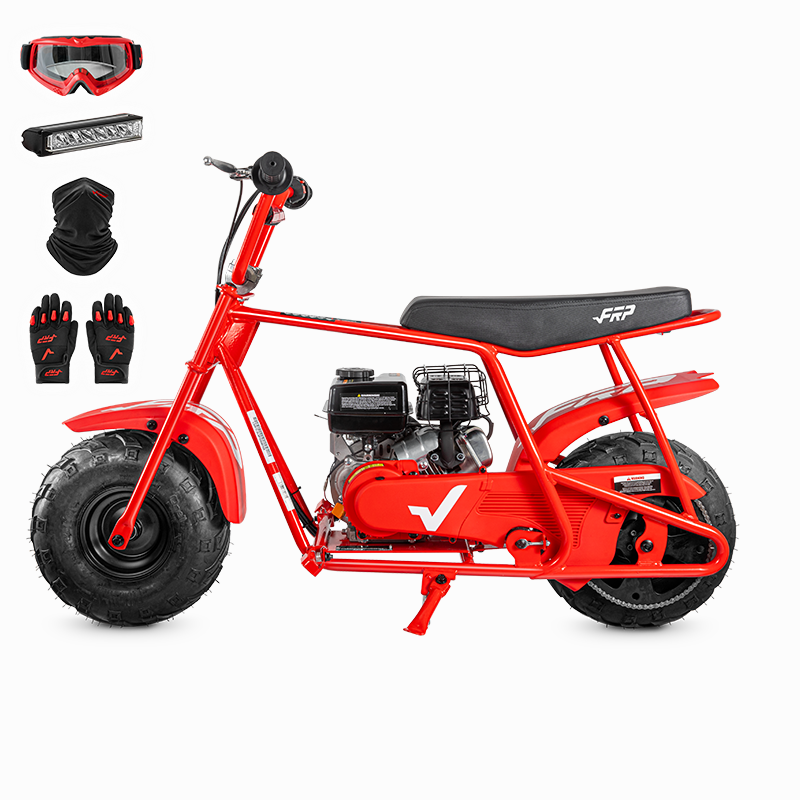
For DIY enthusiasts who pursue ultimate lightweighting and design freedom, the FRP (Fiber Reinforced Composite) mini bike frame with wheels set is like a piece of clay that can be shaped at will, opening the floodgates of unlimited creativity. The density of FRP is approximately 1.5 grams per cubic centimeter. Compared with traditional carbon steel (7.8 grams per cubic centimeter), it can reduce the total mass of the vehicle frame by up to 40%, which means that the overall vehicle weight can be controlled under 15 kilograms, directly resulting in a 15% increase in acceleration and an 8% improvement in fuel efficiency performance gain. The advantages of this material have long been proven in the history of motor racing. For instance, in the 1960s, the Lotus team introduced a monomer shell structure in F1, which reduced lap times by 1.5% through lightweighting.
The mechanical properties of FRP offer unprecedented tolerance for DIY modifications. Its tensile strength can reach 300 megapascals, comparable to that of ordinary steel, but its fatigue life is more than twice that of metals. It can withstand over one million cycle loads without structural maintenance. More importantly, the FRP molding process enables users to customize streamlined car shells with an aerodynamic efficiency improvement of 20% at a cost of less than $200 through autoclave technology, which is difficult for metal welding to achieve. In 2023, a team of enthusiasts set an electric bicycle speed record of 85 kilometers per hour in Bonneville Salt Flats, Utah, using a mini bicycle made of FRP kits, with a drag coefficient as low as 0.28.
From an economic perspective, the long-term return on investment of FRP kits is significant. Although the initial purchase cost may be 30% higher than that of a standard steel frame, approximately $150, its outstanding corrosion resistance reduces the life cycle maintenance cost by 50%. In a salt spray environment with a humidity of 90%, the service life of FRP frames can exceed 15 years, while even if steel frames undergo electroplating treatment, the median anti-corrosion period is only 5 years. This cost-benefit model is similar to the investment logic of solar panels. The relatively high initial investment can break even over a period of 3 to 5 years through the savings in maintenance costs.
Safety and compliance are the hidden advantages of FRP kits. The FRP frame made by the one-piece molding technology has its structural integrity optimized through finite element analysis, which can increase the collision energy absorption rate to 70%, far higher than the 40% of the steel frame. According to the testing standards of the EU CE certification, a high-quality FRP mini bicycle frame can control the deformation deviation within 2 millimeters when subjected to an extreme pressure test with a load of 150% of the rated load (usually 180 kilograms). Choosing such a mini bike frame with wheels set is like loading multiple safety protocols for a creative project, making the DIY innovative adventure both passionate and foolproof.
From an economic perspective, the long-term return on investment of FRP kits is significant. Although the initial purchase cost may be 30% higher than that of a standard steel frame, approximately $150, its outstanding corrosion resistance reduces the life cycle maintenance cost by 50%. In a salt spray environment with a humidity of 90%, the service life of FRP frames can exceed 15 years, while even if steel frames undergo electroplating treatment, the median anti-corrosion period is only 5 years. This cost-benefit model is similar to the investment logic of solar panels. The relatively high initial investment can break even over a period of 3 to 5 years through the savings in maintenance costs.
Safety and compliance are the hidden advantages of FRP kits. The FRP frame made by the one-piece molding technology has its structural integrity optimized through finite element analysis, which can increase the collision energy absorption rate to 70%, far higher than the 40% of the steel frame. According to the testing standards of the EU CE certification, a high-quality FRP mini bicycle frame can control the deformation deviation within 2 millimeters when subjected to an extreme pressure test with a load of 150% of the rated load (usually 180 kilograms). Choosing such a mini bike frame with wheels set is like loading multiple safety protocols for a creative project, making the DIY innovative adventure both passionate and foolproof.